Campaigns
This page covers the per-campaign fields and rollout strategies inside the vaccination block. For the surrounding block structure and flows configuration, see the Overview.
Quick start
The fastest path is using one of the vaccination model presets with a flat-count vaccination campaign (the example below uses V-SEIHR). In the following example, we roll out vaccination starting in February 2025 with a target of 100,000 doses per day held constant across the window. See Dose allocation for how the daily dose count splits across age groups.
curl -X POST https://epyscenario-api.isi.it/api/v1/simulations \
-H "Content-Type: application/json" \
-d '{
  "model": {
    "preset": "V-SEIHR",
    "parameters": {
      "R0": 2.5,
      "incubation_period": 3.0,
      "infectious_period": 2.5,
      "hosp_duration": 5.0,
      "hosp_proportion": 0.05,
      "VE_S": 0.7,
      "VE_H": 0.85
    }
  },
  "population": {"name": "United_States"},
  "simulation": {"start_date": "2025-01-01", "end_date": "2025-06-30", "Nsim": 10},
  "vaccination": {
    "campaigns": [
      {
        "start_date": "2025-02-01",
        "end_date": "2025-04-30",
        "rollout": {"type": "flat_count", "daily_doses": 100000}
      }
    ]
  }
}'
The response includes the resulting Susceptible_to_Susceptible_vax transition series; see Inspecting the rollout for what to look at.
Campaign fields
Each entry in campaigns describes one rollout:
| Field | Required | Description |
|---|---|---|
name | no | Free-text label echoed back in metadata.vaccination. Handy for keeping multiple overlapping campaigns straight. |
start_date | yes | Campaign start (YYYY-MM-DD), inclusive. |
end_date | yes | Campaign end (YYYY-MM-DD), inclusive. Must be ≥ start_date. |
rollout | yes | Rollout strategy. Supported: flat_count, fixed_rate. The type field is the discriminator. See Rollout strategies. |
target_age_groups | no | List of age-group labels (e.g. ["50-64", "65+"]). Must be unique and must match labels from the resolved population. null (the default) means all groups. Empty lists are rejected. |
coverage | no | Optional cap that stops the campaign once vaccinated compartments in target_age_groups reach a target fraction of the initial population. See Coverage cap. |
Rollout strategies
Flat rollout (count)
A constant daily_doses count is scheduled every day across the campaign window, distributed proportionally to the source-compartment population in each targeted age group.
"Flat" refers to the scheduled budget, not the delivered curve: as the source pool depletes (through vaccination, infections, etc.), the actual daily delivered count can drift below daily_doses. If the live pool drops below daily_doses per step, the per-source stochastic draw saturates against the available population; if the pool is empty, no doses are delivered that step. See the Dose allocation section for the per-step competing-risks draw.
| Field | Required | Description |
|---|---|---|
type | yes | Literal "flat_count". The discriminator. |
daily_doses | yes | Target doses delivered per day. Must be > 0. |
curl -X POST https://epyscenario-api.isi.it/api/v1/simulations \
-H "Content-Type: application/json" \
-d '{
  "model": {"preset": "V-SEIR", "parameters": {"R0": 2.5, "VE_S": 0.7}},
  "population": {"name": "United_States"},
  "simulation": {"start_date": "2025-01-01", "end_date": "2025-06-30", "Nsim": 10},
  "vaccination": {
    "campaigns": [
      {
        "start_date": "2025-02-01",
        "end_date": "2025-04-30",
        "rollout": {"type": "flat_count", "daily_doses": 100000}
      }
    ]
  }
}'
Example
Here is an example of V-SEIR model run on a 1,000,000 homogeneous population (, , 0.02% initial infections, no waning), with a single campaign scheduled at 5,000 doses/day from Feb 1 to Oct 15, 2025 (100 stochastic runs, median plotted).
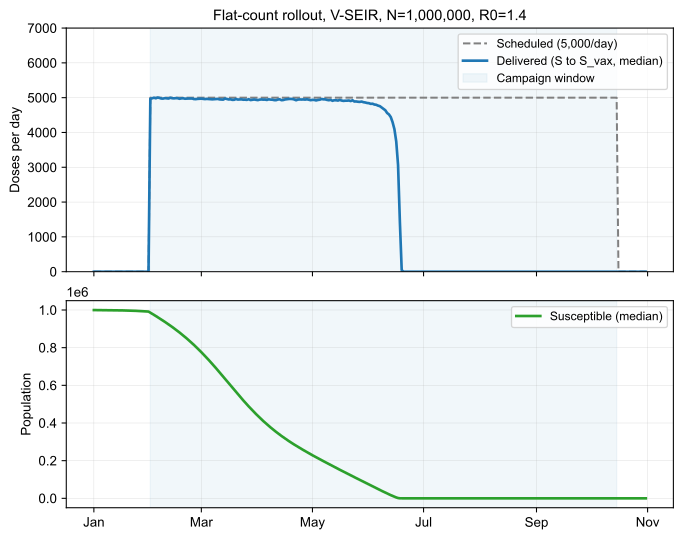
The scheduled budget (dashed) holds at 5,000/day across the entire window, but the delivered count drops to zero around the end of May as is exhausted by the epidemic plus vaccination.
Fixed rate (per-day hazard)
A constant per-day hazard rate, tansitioning from source compartment to the target inside the window. This is identical to a 'spontaneous transition' at rate (restricted to target_age_groups and the campaign window). Every individual in a source compartment has a per-day probability of 1 - exp(-rate * dt) of moving to the target.
Use this when you want to express vaccination as a rate rather than a daily count. Unlike flat_count, the per-day flow scales with the current source pool, so the analytic decay holds in the absence of competing transitions.
| Field | Required | Description |
|---|---|---|
type | yes | Literal "fixed_rate". The discriminator. |
rate | yes | Per-day hazard rate. Must be > 0. |
curl -X POST https://epyscenario-api.isi.it/api/v1/simulations \
-H "Content-Type: application/json" \
-d '{
  "model": {"preset": "V-SEIHR", "parameters": {"R0": 2.5, "VE_S": 0.7, "VE_H": 0.85}},
  "population": {"name": "United_States"},
  "simulation": {"start_date": "2025-01-01", "end_date": "2025-06-30", "Nsim": 10},
  "vaccination": {
    "campaigns": [
      {
        "start_date": "2025-02-01",
        "end_date": "2025-04-30",
        "rollout": {"type": "fixed_rate", "rate": 0.005}
      }
    ]
  }
}'
Example
Same V-SEIR setup as the flat-count example (1,000,000 homogeneous population, , , 0.02% initial infections, no waning) but driven by a fixed_rate campaign at rate=0.005/day from Feb 1 to Oct 15, 2025 (100 stochastic runs, median plotted). The rate is chosen so the initial per-day delivery () matches the flat-count budget, making the two plots directly comparable.
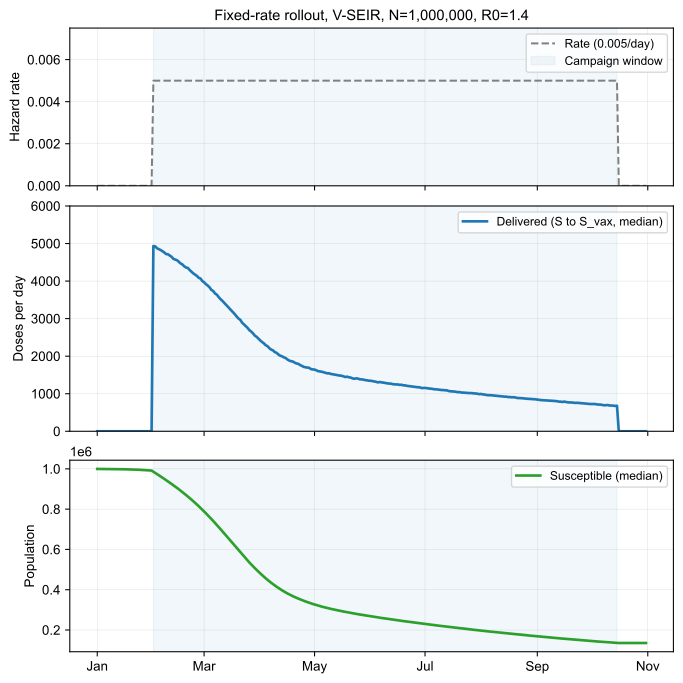
As seen in the top figure, the hazard rate (top) is the constant during the campaign period. Every individual in the source has the same per-day probability of being vaccinated throughout the window. The delivered per-day count (middle) is therefore , declining smoothly as (bottom) shrinks rather than holding flat.
Coverage cap
Both rollout strategies are time-based: they keep delivering at their configured pace until end_date, regardless of how much of the population has already been vaccinated. The optional coverage block on each campaign adds a stop condition.
"coverage": {
  "fraction": 0.7,
  "compartments": ["S_vax", "E_vax", "I_vax", "R_vax"]
}
Once the summed current occupancy of compartments, restricted to the campaign's target_age_groups, reaches fraction * initial_population_in_target_age_groups, the campaign stops contributing to the rate. initial_population_in_target_age_groups is summed at the campaign's start_date across all compartments in those age groups (the public-health convention).
| Field | Required | Description |
|---|---|---|
fraction | yes | Cap as a fraction of initial population in target_age_groups. Must satisfy 0 < fraction ≤ 1. |
compartments | yes | List of compartments whose current occupancy is summed against the threshold. Must reference compartments declared in model.compartments, and cannot include any compartment that also appears as a source in the campaign's flows (otherwise the cap fires before any doses are delivered). |
Note the following:
- Current occupancy, not cumulative ever-vaccinated. The cap reads the live state of
compartments. If individuals can leave the vaccinated branch (waning back toS, death), the cap will under-count. List every downstream vaccinated compartment, including absorbing states likeD_vaxif your model has them, to match the intuitive notion of coverage. - Approximate threshold. The cap is evaluated at the start of each step, before the multinomial draw. Therefore, the campaign plateaus at approximately
threshold, with up to one step's worth of doses of overshoot.
Custom-model usage
You can define a custom model that incorporates the effects of vaccination and takes advantage of the vaccination block. What you need is a model whose compartments include both a source and a vaccinated target, and (typically) a vaccinated layer that mirrors the unvaccinated transitions with vaccine-efficacy-attenuated rates. The block then drives doses across the source → target pairs declared in flows. You can model the effects of vaccination through transformed parameters (e.g. severity reduction) and additional transitions.
On a custom model the flows field is required; there is no default. Every source and (non-null) target must reference a compartment declared in model.compartments.
curl -X POST https://epyscenario-api.isi.it/api/v1/simulations \
-H "Content-Type: application/json" \
-d '{
  "model": {
    "compartments": ["S", "V", "I", "R"],
    "parameters": {
      "transmission_rate": 0.3,
      "transmission_rate_v": "(1 - VE_S) * transmission_rate",
      "VE_S": 0.7,
      "recovery_rate": 0.1
    },
    "transitions": [
      {"source": "S", "target": "I", "kind": "mediated", "params": ["transmission_rate", "I"]},
      {"source": "V", "target": "I", "kind": "mediated", "params": ["transmission_rate_v", "I"]},
      {"source": "I", "target": "R", "kind": "spontaneous", "params": ["recovery_rate"]}
    ]
  },
  "population": {"name": "Italy"},
  "simulation": {"start_date": "2025-01-01", "end_date": "2025-06-30", "Nsim": 10},
  "vaccination": {
    "flows": [{"source": "S", "target": "V"}],
    "campaigns": [
      {
        "start_date": "2025-02-01",
        "end_date": "2025-03-31",
        "rollout": {"type": "flat_count", "daily_doses": 50000}
      }
    ]
  }
}'
Multiple campaigns
Listing more than one campaign lets you stack rollouts. Two overlapping flat_count campaigns add their daily doses at every step. Use this for booster waves, prioritization changes (e.g. open eligibility on a given date by adding a younger-age campaign mid-rollout), or to compare a baseline campaign against an accelerated counterfactual.
curl -X POST https://epyscenario-api.isi.it/api/v1/simulations \
-H "Content-Type: application/json" \
-d '{
  "model": {
    "preset": "V-SEIHR",
    "parameters": {"R0": 2.5, "VE_S": 0.7, "VE_H": 0.85}
  },
  "population": {
    "name": "United_States",
    "contacts_source": "prem_2021",
    "age_group_mapping": {
      "0-17":  ["0-4", "5-9", "10-14", "15-19"],
      "18-49": ["20-24", "25-29", "30-34", "35-39", "40-44", "45-49"],
      "50-64": ["50-54", "55-59", "60-64"],
      "65+":   ["65-69", "70-74", "75+"]
    }
  },
  "simulation": {"start_date": "2025-01-01", "end_date": "2025-06-30", "Nsim": 10},
  "vaccination": {
    "campaigns": [
      {
        "name": "phase 1 (older adults)",
        "start_date": "2025-02-01",
        "end_date": "2025-03-31",
        "target_age_groups": ["65+"],
        "rollout": {"type": "flat_count", "daily_doses": 40000}
      },
      {
        "name": "phase 2 (open eligibility)",
        "start_date": "2025-03-15",
        "end_date": "2025-05-31",
        "target_age_groups": ["18-49", "50-64", "65+"],
        "rollout": {"type": "flat_count", "daily_doses": 80000}
      }
    ]
  }
}'